Kidney stones are a common urological problem that can cause
severe pain, discomfort, and urinary difficulties. It is
estimated that approximately 12% of the Indian population may
suffer from stones during their lifetime. Some stones remain
unnoticed for a long time, while others may cause sudden,
intense pain that requires urgent medical attention.
If you or someone in your family is experiencing kidney stone
symptoms, understanding the condition and seeking timely
medical advice can help prevent complications.
As a Consultant Urologist, I evaluate kidney stone problems
and recommend treatment based on the stone's size, location,
composition, symptoms, kidney function, and your overall health.
My goal is to help you understand your condition, explore
appropriate treatment options, and make an informed decision
about your urinary health.
What Are Kidney Stones?
Kidney stones are hard deposits of insoluble compounds formed
when minerals and salts in the urine crystallise and accumulate
inside the urinary tract.
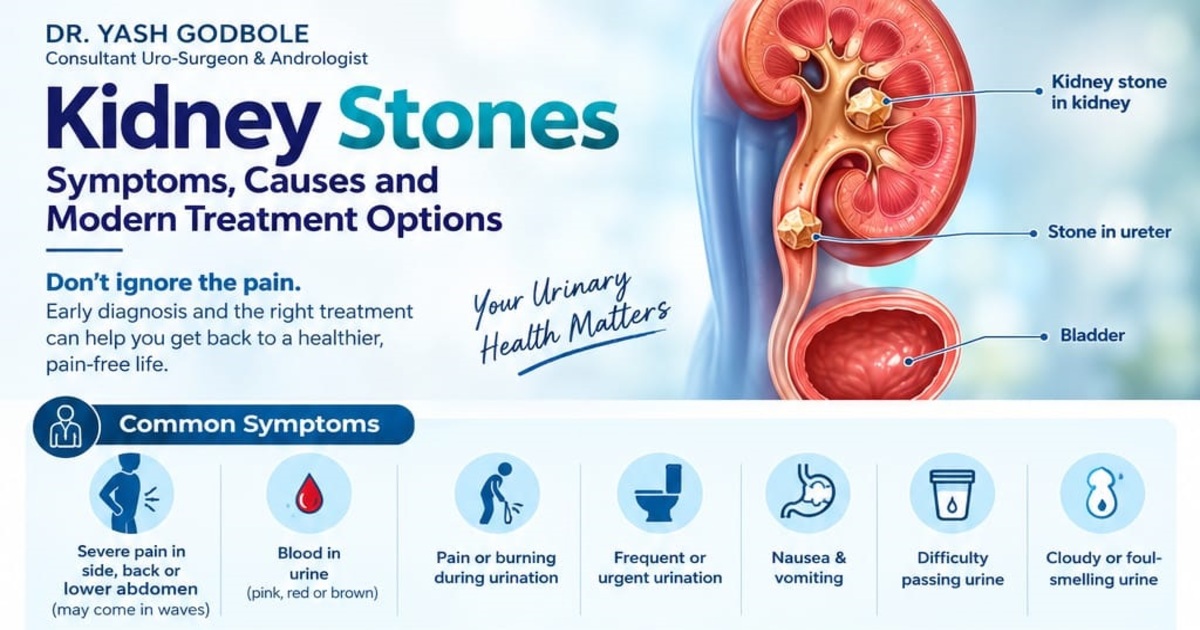
They can develop in the kidneys and may move into the ureter,
the tube that carries urine from the kidney to the bladder.
If a stone obstructs urine flow, it can cause significant pain
and, in some cases, damage to the affected kidney if the
obstruction is not managed appropriately.
Kidney stones vary in size. Small stones may pass naturally,
whereas larger stones or those causing obstruction may require
a medical procedure. Not every kidney stone requires surgery.
The appropriate treatment depends on an individual assessment.
What Are the Common Symptoms of Kidney Stones?
Kidney stone symptoms can vary depending on the size and
location of the stone and whether it is blocking urine flow.
Common warning signs include:
-
Severe pain in the side or back:
Pain may come in waves and can spread towards the lower
abdomen or groin, commonly described as loin-to-groin pain.
-
Blood in the urine (hematuria):
Urine may appear pink, red, or brown, although blood may
only be detectable on testing.
-
Pain or burning during urination:
Known as dysuria, this can occur when a stone moves towards
the bladder or urethra.
-
Increased urinary frequency:
Particularly when a stone is close to the bladder or
vesico-ureteric junction.
-
Nausea and vomiting:
These can accompany severe stone pain.
-
Difficulty passing urine:
This may indicate obstruction or another urinary problem.
-
Cloudy or foul-smelling urine:
This can occur with infection and requires assessment.
Some kidney stones cause no symptoms and are discovered
incidentally during an ultrasound or other imaging examination.
Important: Seek urgent medical attention if
you have severe pain with fever or chills, persistent vomiting,
difficulty passing urine, or symptoms suggesting infection.
An infected, obstructed kidney is a medical emergency.
Why Do Kidney Stones Form?
Kidney stones can develop for several reasons.
-
Inadequate fluid intake:
When you do not drink enough fluids, urine becomes more
concentrated, allowing crystals to form more easily.
This can be especially relevant in humid coastal regions,
where sweating and other water losses may increase the
need for hydration.
-
Dietary factors:
Excessive salt intake and certain dietary patterns may
increase the risk of particular types of stones.
Diets rich in processed foods and preservatives may also
influence urinary composition.
-
Family history:
Having close relatives with kidney stones can increase
your likelihood of developing them.
-
Metabolic conditions:
Some people have elevated levels of calcium, oxalate,
uric acid, or other stone-forming substances in their urine.
In patients with metabolic or congenital conditions,
monitoring these compounds may be an important part
of management.
-
Medical conditions:
Certain intestinal disorders, recurrent urinary infections,
metabolic abnormalities, and other health conditions can
contribute to stone formation.
-
Previous kidney stones:
People who have experienced kidney stones once may develop
them again, especially if the underlying risk factors are
not addressed.
The cause is not always obvious. For patients with recurrent
stones or a higher risk of recurrence, further investigation
can help identify contributing factors and guide prevention.
When Should You See Me for Kidney Stones?
I recommend consulting me if you experience symptoms that may
indicate a kidney stone or if an imaging examination has
already identified one.
Consider a urological evaluation if you have:
- Recurrent pain in your side, back, or lower abdomen.
- Blood in your urine.
- A kidney or ureteric stone detected on ultrasound or CT scan.
- A stone that is not passing naturally.
- Repeated episodes of kidney stones.
- A history of kidney stone surgery with new or persistent symptoms.
- Difficulty passing urine or concerns about obstruction.
Even if a stone is not causing pain, medical assessment is
important to determine whether it can be safely monitored
or requires treatment. Some stones, including staghorn
calculi, can become large without causing obvious symptoms.
Seek emergency care for fever or chills with suspected kidney
stones, inability to pass urine, or severe symptoms that
cannot be controlled. Do not wait for a routine appointment
if these warning signs occur.
What Can You Expect During Your Consultation?
My approach begins with understanding your symptoms and
identifying the most appropriate management strategy for
your particular condition.
1. Detailed Clinical Assessment
I will review your symptoms, previous kidney stone episodes,
medical history, current medicines, and available investigation
reports.
2. Diagnostic Investigations
Depending on your condition, I may recommend:
-
Ultrasound of the kidneys, ureters and bladder:
To assess the urinary tract and look for stones or signs
of obstruction.
-
CT scan without contrast:
Often useful when more detailed information about stone
size, location, and obstruction is required.
-
Urine tests:
To check for blood, infection, and other abnormalities.
-
Blood tests:
To assess kidney function and identify relevant metabolic
abnormalities.
-
Stone analysis or metabolic evaluation:
Particularly for selected patients with recurrent or
high-risk stones.
Not every patient requires every test. Investigations are
selected according to symptoms, clinical findings, and
existing reports.
3. A Personalised Treatment Plan
Once the necessary information is available, I will explain
the treatment options appropriate for your stone, including
the possibility of natural passage, observation, medication
where indicated, or a procedure.
I will discuss the expected benefits, limitations, potential
risks, and recovery considerations to help you make an
informed decision.
Modern Kidney Stone Treatment Options
Treatment depends on the stone's size, location, composition,
symptoms, degree of obstruction, infection status, kidney
function, and likelihood of passing naturally.
1. Observation and Medical Management
Some small stones can pass naturally without surgery.
When observation is appropriate, I may recommend follow-up
imaging, pain management, and selected medicines to support
stone passage. Medication is not suitable for every stone,
and follow-up is important to ensure that the stone has passed
and the kidney remains safe.
2. URSL — Ureteroscopic Stone Removal
Ureteroscopy with laser lithotripsy, commonly called URSL
when treating ureteric stones, involves passing a small
endoscope through the urinary passage to reach the stone.
The stone can then be fragmented using a suitable laser,
and fragments may be removed as appropriate. A temporary
DJ stent may be required in selected cases.
This procedure is commonly considered for ureteric stones
that are unlikely to pass naturally or require active treatment.
3. RIRS — Retrograde Intrarenal Surgery
RIRS is a minimally invasive endoscopic procedure used to
treat selected kidney stones.
A flexible ureteroscope is passed through the natural urinary
passage into the kidney. A suitable laser is used to fragment
the stone, and the fragments may be removed or allowed to pass
depending on the circumstances.
RIRS may be appropriate for many kidney stones, particularly
when a flexible endoscopic approach is suitable. The choice
of laser and technique depends on the case and available
equipment.
4. PCNL — Percutaneous Nephrolithotomy
PCNL is a procedure in which a small access tract is created
through the skin into the kidney to remove stones.
It is commonly considered for large, complex, or staghorn
kidney stones and certain other stones for which this approach
offers an appropriate treatment option.
PCNL can achieve effective stone clearance in suitable
patients, but the risks, recovery, and suitability depend
on individual clinical factors.
Which Kidney Stone Procedure Is Right for You?
There is no single procedure that is best for every patient.
-
URSL:
Often considered for suitable ureteric stones.
-
RIRS:
Often considered for suitable kidney stones treated
through a flexible endoscope.
-
PCNL:
Commonly considered for large or complex kidney stones.
The final recommendation depends on your scan findings,
stone characteristics, kidney anatomy, medical fitness,
and treatment goals. Some patients may require more than
one procedure or a staged treatment plan.
How Can I Help You Manage Your Kidney Stone Problem?
My role is not limited to treating the existing stone.
I also aim to help you understand why it formed and how
to reduce the risk of future stones.
As your urologist, I can help with:
-
Accurate diagnosis:
Identifying the stone's size, location, and potential
impact on kidney function.
-
Appropriate treatment selection:
Determining whether observation, medical management,
URSL, RIRS, PCNL, or another approach is suitable.
-
Management of obstruction and complications:
Assessing urgent problems and arranging appropriate
treatment when necessary.
-
Recovery guidance:
Explaining follow-up, stent care where applicable,
return to routine activities, and any precautions
specific to your procedure.
-
Prevention of recurrence:
Reviewing stone analysis, dietary habits, fluid intake,
and metabolic risk factors to develop an appropriate
prevention plan.
My aim is to provide individualised care based on your
diagnosis rather than recommending the same treatment
to every patient.
How Can You Reduce the Risk of Kidney Stones?
Although not every kidney stone can be prevented, certain
measures may help reduce the risk of recurrence.
-
Maintain adequate hydration:
Drink enough fluids to produce a good volume of urine,
unless your doctor has advised fluid restriction.
Your target may depend on your health and stone type.
-
Reduce excess salt:
High sodium intake can increase urinary calcium in
some people.
-
Maintain a balanced diet:
Avoid unnecessarily eliminating calcium-rich foods.
Normal dietary calcium is generally recommended for
most people with calcium stones, unless advised otherwise.
-
Avoid excessive supplements:
Take calcium, vitamin C, or other supplements in
consultation with your clinician when you have a
history of stones.
-
Follow stone-specific dietary advice:
Different stones may require different preventive measures.
-
Attend follow-up appointments:
Recurrent or high-risk stone formers may benefit from
stone analysis and a metabolic evaluation.
Prevention should be tailored to the type of stone and
your individual risk factors.
Do Not Ignore Your Kidney Stone Symptoms
Kidney stones can range from small stones that pass naturally
to complex stones that require specialised treatment. Timely
evaluation helps determine which category applies to you and
whether the stone is putting your kidney at risk.
If you have been diagnosed with a kidney stone or are
experiencing symptoms, I encourage you to seek appropriate
medical advice rather than delaying assessment.
Consult Dr. Yash Godbole, Consultant Uro-Surgeon &
Andrologist, for an evaluation of your kidney stone problem
and guidance on suitable treatment options.